Core self-evaluation é o traço de fundo que separa executivos que assumem o volante da própria trajetória daqueles que reagem às forças do ambiente. Quem tem avaliação nuclear de si mais alta formula metas mais ousadas, persiste sob incerteza, interpreta contratempos como transitórios e converge para posições de liderança com mais probabilidade. Não é otimismo vazio: é a combinação estrutural de autoestima, autoeficácia, locus interno e estabilidade emocional, que altera como o executivo lê o mundo e reage a ele — e por isso tem poder preditivo sobre resultados duros em carreira.
Core Self-Evaluation: the Psychological Root of Executive Goal-Setting, Persistence, and Leadership Performance
Self-Core Evaluation (SCE) - or "What I am able to do and to control?" - is a higher-order personality factor that bundles four core self-judgments:
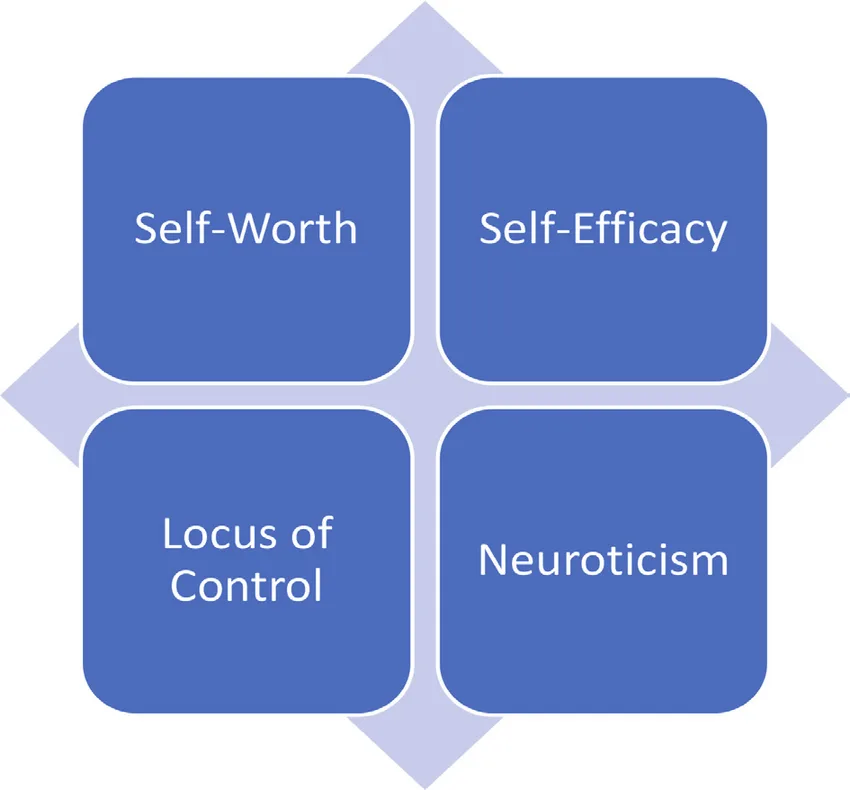
- Self-esteem
- Self-efficacy
- Internal locus of control
- Emotional stability
Self-efficacy has been linked to performance (Judge, Locke and Durham, 1988), and SCE was later formalized as the latent construct explaining the covariance among the four traits (Judge et al., 1997). High-SCE individuals tend to set higher goals, persist longer, interpret obstacles as temporary, report higher subjective well-being and achieve better objective outcomes, whereas low-SCE individuals set lower goals, disengage sooner, interpret neutral events as threats and report more rumination and strain. There is a consistent association with job satisfaction (Judge and Bono, 2001), and high-SCE individuals are more likely to emerge as leaders, be evaluated as more effective and shape more stable environments (Bono and Judge, 2003).
The four traits are plastic at meaningful magnitudes but move only as second-order consequences of repeated behavioral evidence rather than by direct will. SCE increases when a person accumulates mastery experiences on tasks with rising difficulty (Bandura, 1997). Internal locus shifts when contingency between effort and outcome is experienced and the agent is forced to articulate counterfactuals about which action caused the result. Emotional stability increases when physiological noise is reduced through sleep regularity, exposure, affect labeling and rules-based decision routines. Self-esteem rises when competence and agency are earned instead of affirmed.
You can check emotional stability in the Big 5.
Another concept worth visiting is: Groth Mindset
Reference
Bandura, A. (1997). Self-efficacy: The exercise of control. New York: Freeman.https://books.google.com/books?id=uZgFAQAAIAAJ
Bono, J. E., & Judge, T. A. (2003). Core self-evaluations: A review of the trait and its role in job satisfaction and job performance. European Journal of Personality, 17(S1), S5–S18.https://doi.org/10.1002/per.481
Costa, P. T., & McCrae, R. R. (1992). Revised NEO Personality Inventory (NEO-PI-R) and NEO Five-Factor Inventory (NEO-FFI) professional manual. Odessa, FL: PAR.https://www.parinc.com/Products/Pkey/237
Judge, T. A., Erez, A., Bono, J. E., & Thoresen, C. J. (2003). The core self-evaluations scale: Development of a measure. Personnel Psychology, 56(2), 303–331.https://doi.org/10.1111/j.1744-6570.2003.tb00152.x
Judge, T. A., & Bono, J. E. (2001). Relationship of core self-evaluations traits with job satisfaction and job performance: A meta-analysis. Journal of Applied Psychology, 86(1), 80–92.https://doi.org/10.1037/0021-9010.86.1.80
Judge, T. A., Locke, E. A., & Durham, C. C. (1997). The dispositional causes of job satisfaction: A core self-evaluations approach. Research in Organizational Behavior, 19, 151–188.https://psycnet.apa.org/record/1998-07850-005
Roberts, B. W., Walton, K. E., & Viechtbauer, W. (2006). Patterns of mean-level change in personality traits across the life course: A meta-analysis of longitudinal studies. Psychological Bulletin, 132(1), 1–25.https://doi.org/10.1037/0033-2909.132.1.1
Schwarzer, R., & Jerusalem, M. (1995). Generalized Self-Efficacy Scale. In J. Weinman, S.
Wright, & M. Johnston (Eds.), Measures in health psychology (pp. 35–37). Windsor: NFER-NELSON.http://userpage.fu-berlin.de/~health/selfscal.htm